

Foundation Memorial to the Murdered Jews of Europe
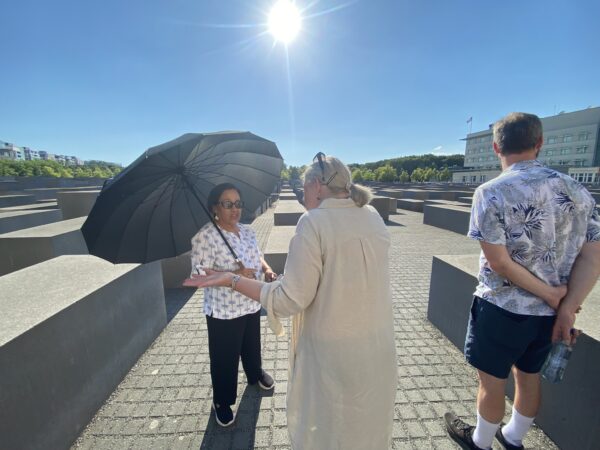
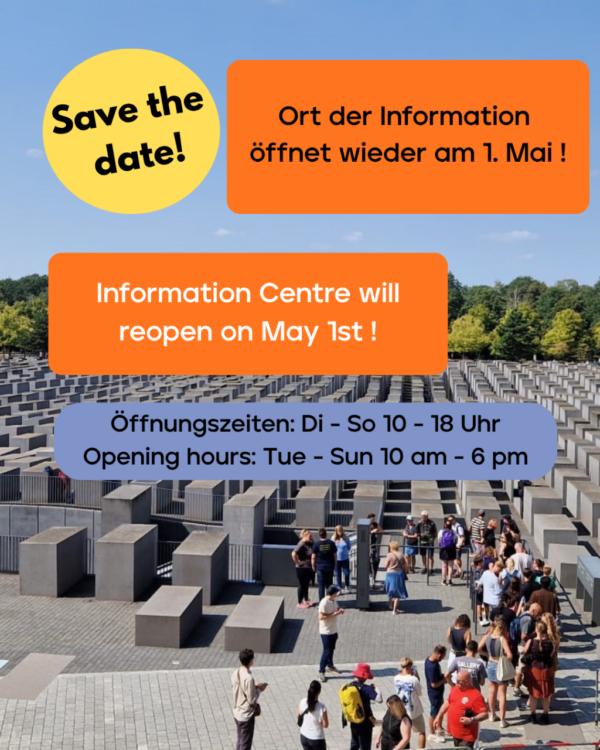
The foundation Memorial to the Murdered Jews of Europe was founded on April 6, 2000, following a cross-party resolution of the German Bundestag on June 25, 1999, to build a central memorial to the murdered Jews of Europe. Established as a foundation under public law, it was responsible for planning and constructing the Field of Stelae – designed by the american architect Peter Eisenman- and the underground Information Centre between 2003 and 2005. The memorial was officially opened to the public on May 10, 2005.
In accordance with its legal mandate, the foundation is also obliged to contribute to ‘ensuring the memory of all victims of National Socialism and their commemoration in an appropriate manner’ and to refer to ‘authentic sites of remembrance’. In addition to maintaining the Memorial to the Murdered Jews of Europe, the foundation is responsible for other memorials: the Memorial to the Persecuted Homosexuals (2008), the Memorial to the Sinti and Roma of Europe Murdered under National Socialism (2012), the Memorial and Information Centre for the Victims of National Socialist ‘Euthanasia’ Murders (2014), and the Memorial to the Persecuted and Murdered Jehovah’s Witnesses (2026), which was approved by the Bundestag in 2023. The Foundation’s travelling exhibitions commemorate the victims of Nazi military justice (2007) and ‘The Denied’, those persecuted as ‘anti-social’ and ‘professional criminals’ (2024).
At the end of 2025, the Bundestag also decided to erect a memorial to the Polish victims of National Socialism and German occupation in Poland from 1939 to 1945, which will also be maintained by the Foundation Memorial to the Murdered Jews of Europe in future.The foundation’s ever-growing online exhibition ‘Not with us – Persecution of young people under National Socialism’, which presents biographies of young people from all over Europe who were persecuted and in some cases even murdered by the National Socialists between 1933 and 1945 for ‘racial’, political, religious and other reasons, currently features over 50 biographies. In addition, the foundation has published 25 eyewitness accounts since 2010.
The Discussion on the Memorial
The resolution passed by the Bundestag was preceded by an intensive discussion process that continued over several years. The initial step was taken in 1988 by a circle of people around the journalist Lea Rosh. In the following years, the Association Memorial to the Murdered Jews of Europe succeeded in winning the support of large sections of the community for the construction of a »prominent memorial dedicated to the murdered Jews of Europe.« Since the start of this discussion, much has changed in Germany. Reunification and the relocation of parliament and government to Berlin – the old and new capital of Germany – have made the Memorial project the subject of a fundamental debate concerning German people’s historical self-awareness at the end of the 20th century. From the outset, this process of self-understanding has involved vigorous criticism and conflicting feelings, and the Memorial was correspondingly the subject of a great deal of fervent argument.
The debate on the Memorial project, which preceded the start of construction itself, illustrates the enormous significance of the project. Active and lively discussions will continue to accompany the Memorial and the Information Centre.
Resolution by the German Bundestag of 25 June 1999 concerning the Memorial to the Murdered Jews of Europe
1.1 The Federal Republic of Germany will erect a memorial to the murdered Jews of Europe in Berlin.
1.2 With the memorial we intend to
- honour the murdered victims,
- keep alive the memory of these inconceivable events in German history
- admonish all future generations never again to violate human rights, to defend the democratic constitutional state at all times, to secure equality before the law for all people and to resist all forms of dictatorship and regimes based on violence.
1.3 The memorial will be a central monument and place of remembrance, connected to other memorial centres and institutions within and beyond Berlin. It cannot replace the historical sites of terror where atrocities were committed.
1.4 The memorial will be erected at the designated site in the centre of Berlin – the Ministry Gardens.
1.5 The Federal Republic of Germany remains committed to commemorating and honouring the other victims of the Nazi regime.
2. Peter Eisenman’s scheme for a Field of Stelae (Eisenman II) will be realised. Incorporated in the concept is an Information Centre referring to the commemorated victims and the historical sites of remembrance.
3. A foundation under public law will be set up with representatives from the German Bundestag, the Federal Government, the State of Berlin and the Association for the Memorial to the Murdered Jews of Europe. The committees will comprise members representing Memorial Centres, the Central Council of Jews in Germany and victims’ associations, as well as other experts. The Foundation shall implement the resolutions passed by the German Bundestag. The Foundation shall ensure that all the victims of the Nazi regime are remembered and honoured appropriately.